
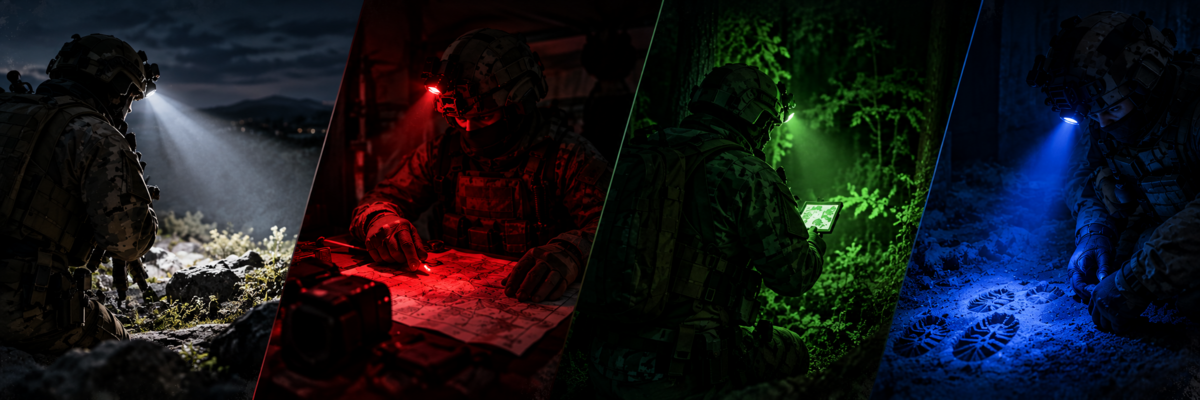
Red, green, white and blue light: why does a military flashlight need different colors?
| Color | Main purpose | Visibility to the eyes | Typical use |
|---|---|---|---|
| ⚪ White | Maximum illumination | High | Movement, work |
| 🔴 Red | Preserving dark adaptation | Moderate | Map, equipment, camp |
| 🟢 Green | Working in low light | High for the eye | Navigation, instruments |
| 🔵 Blue | Specialized tasks | High | Search, marking |
White light
White light is the primary mode of a tactical flashlight when maximum visibility is required. It provides the best overall illumination and allows you to clearly see shapes, terrain, colors and small details.
In military conditions, white light is used for moving in the dark, observing the surroundings, working with equipment, searching for objects and quickly illuminating a required area.
The main advantage of white light is its versatility. When you need to clearly see what is in front of you, this mode will usually be the first choice.

Example:
flashlight with white light.
Red light
Red light has a completely different purpose. Its main advantage is a lower impact on the eyes' adaptation to darkness compared with bright white light.
That is why the red mode is often used when you need to see something or perform a task without completely losing your eyes' adaptation to darkness.
Red light is convenient when working with maps, documents, notes or equipment in a dark room, shelter or camp.
At the same time, the red mode should not be considered “invisible light”. It can still be noticeable from a distance — everything depends on the flashlight's power, terrain conditions and ambient light.

Example:
flashlight with red light
Green light
Green light is well perceived by the human eye and can provide comfortable visibility of details at relatively low brightness. That is why green mode is found in multifunctional tactical flashlights.
It can be used for a quick check of a route, terrain, equipment, maps and other objects in field conditions.
The green beam works particularly well against natural backgrounds such as vegetation, soil and other surfaces. However, like any colored light, it has its own characteristics and does not replace white light when accurate color and detail reproduction is required.

Example:
flashlight with green light
Blue light
Blue light is a more specialized mode. For general illumination, it is less versatile than white light, but it can be useful in situations where a certain type of contrast is needed or when examining details that are more noticeable under blue illumination.
In tactical flashlights, blue mode can be used for equipment inspection, searching for certain traces or substances, working with details and specialized tasks.

Why have several modes?
In field conditions, there is no single universal scenario for using a flashlight. White light is needed for maximum visibility, red light for working with less impact on the eyes' adaptation to darkness, green light for comfortable illumination in certain field situations, and blue light for specialized tasks.
That is why a multifunctional tactical flashlight with several colors can be much more practical than a model with only one mode.


